
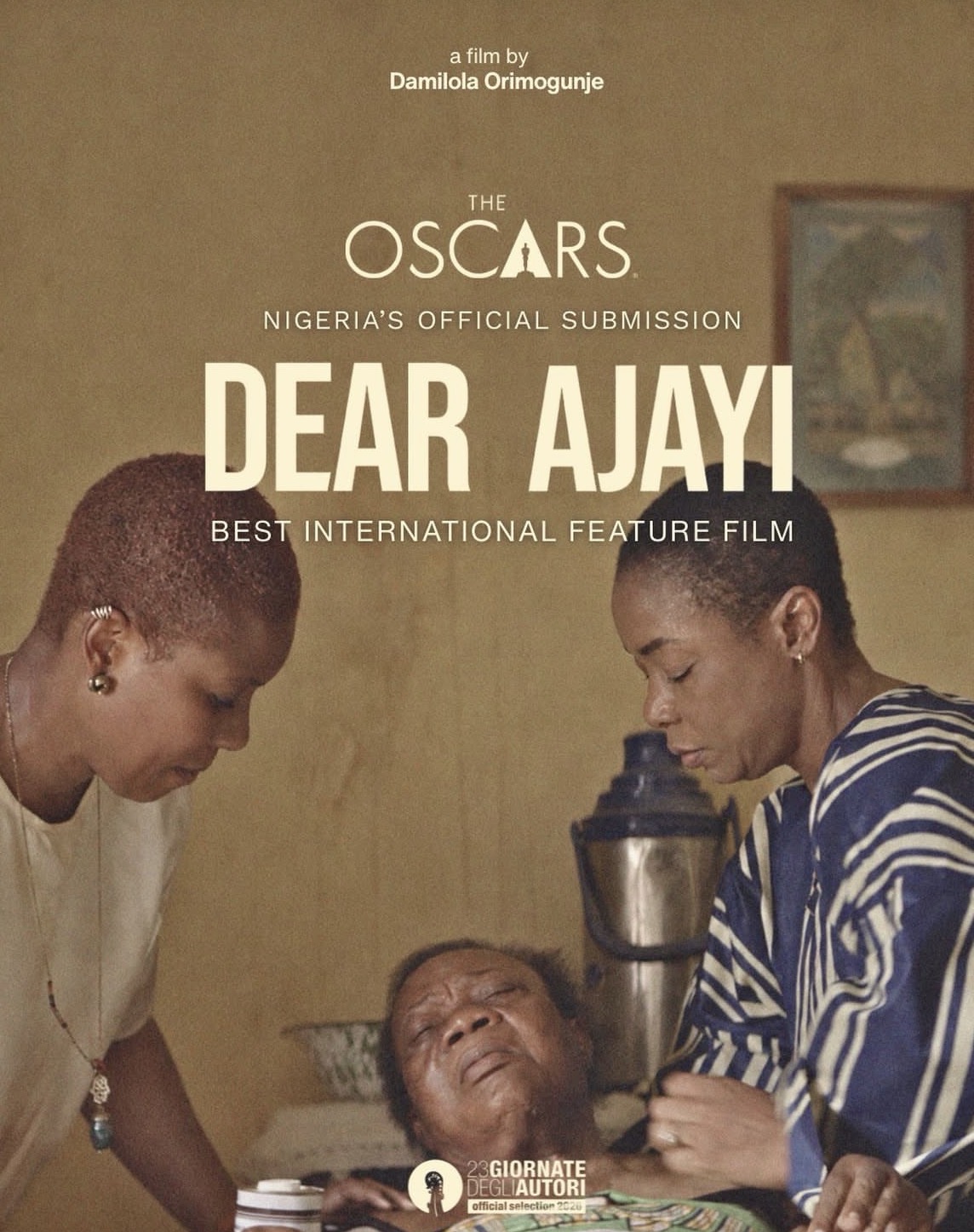
Nigeria has selected Damilola Orimogunje’s Dear Ajayi to represent the country at the 99th Academy Awards. But as the film makes its way through Nigerian cinemas, its domestic box-office performance and the seemingly limited public conversation surrounding it raise bigger questions about audience preferences, government support and the industry’s willingness to embrace intimate, everyday stories.
There is something rather ironic about a country sending a film to represent its cinema on one of the world’s biggest entertainment stages while struggling to generate the kind of domestic excitement that might be expected to accompany such an achievement.
On October 4, 2026, the Nigerian Official Selection Committee announced Damilola Orimogunje’s Dear Ajayi as Nigeria’s official submission for the Best International Feature Film category at the 99th Academy Awards. The announcement marked Nigeria’s return to the category after not submitting an entry for the previous edition. For the filmmakers, it was a significant milestone. For Nigerian cinema, it was another opportunity to make its presence felt internationally.
The selection followed the film’s international festival journey, which included its world premiere in competition at the 2026 Giornate degli Autori, a sidebar of the Venice International Film Festival, where it won the Bisato d’Oro for Best Cast and Performances and the CICT-UNESCO Enrico Fulchignoni Prize.”
Yet, while the international recognition generated headlines and congratulatory messages, the film’s journey at home has presented a rather different picture.
Released in Nigerian cinemas on November 13, following an earlier limited theatrical run that began in September, Dear Ajayi has struggled to generate significant box-office momentum. Data published by the Nigerian Movie Database puts its reported domestic gross at approximately ₦10.47 million, with an opening figure of ₦1.63 million for its initial September run. The film’s release history, including its subsequent wider theatrical rollout, makes it important to distinguish between the initial opening and its later performance.
Regardless of the reporting window, the figures invite a conversation about the commercial realities facing films like this.
How does a film selected to represent Nigeria internationally struggle to attract a substantial audience in its own country? And what does that say about the relationship between Nigerian filmmakers, their audiences and the institutions expected to support the industry?
An Oscar Submission, but Where is the National Support?
Being selected as a country’s official Oscar submission is a considerable achievement, but it is also the beginning of another demanding journey.
The Academy Awards process requires more than producing a good film. It also involves the business of international visibility, industry screenings, publicity, campaigning, and getting the film in front of the right people. These activities require considerable resources, particularly for independent filmmakers and productions without the financial backing of major international studios.
For Dear Ajayi, navigating this process raises an important question about the Nigerian government’s involvement in promoting its own cultural exports.
What happens after Nigeria selects a film to represent it internationally?
Does the responsibility end with the Nigerian Official Selection Committee announcing its choice, or should there be a more coordinated national effort to support the film’s journey?
The Ministry of Art, Culture, Tourism and the Creative Economy, alongside relevant cultural institutions, has an opportunity to play a more active role in promoting Nigerian cinema. This could include facilitating international publicity, supporting industry screenings, establishing relationships with cultural institutions abroad, and providing structured assistance for films selected to represent the country.
There is currently no publicly established account of a dedicated government-backed Oscar campaign for Dear Ajayi
So the question is: should filmmakers bear the financial and promotional responsibility of representing Nigeria internationally without a coordinated national support structure?
Nigeria has repeatedly expressed ambitions to position its creative industry as an important contributor to the country’s global image and economy. Supporting films that carry the country’s name onto international platforms should arguably form part of that ambition.
National representation should mean more than attaching the country’s name to a submission.
Do Nigerians have Room for Everyday Stories?
Perhaps the more complicated question is not about government support but the audience itself.
In a recent interview with ARISE News, Orimogunje spoke about the need for Nigerian cinema to embrace simple, relatable stories about ordinary people. According to the filmmaker, Nigerian stories do not always have to revolve around extraordinary circumstances or elaborate narratives. Sometimes, the most compelling stories are about the people we encounter every day, their relationships, sacrifices, and struggles.
It is an interesting position, particularly when considered against the commercial realities of Nigerian cinema.
Dear Ajayi is a family drama set in southwestern Nigeria in the 1990s. It follows two estranged sisters, Ade and Titi, who are forced to live together while caring for their paralysed mother. One is a devout Christian and the family’s breadwinner, while the other is an aspiring singer whose independent personality challenges the expectations placed upon her.
Through their relationship, the film explores family obligations, faith, ambition, female identity, sacrifice, and the different ways people respond to society’s expectations.
These are not necessarily unfamiliar experiences to Nigerian audiences. They are, in many ways, reflections of ordinary Nigerian households.
However, the commercial reception of films that prioritise these intimate experiences raises questions about what audiences want from cinema.
Consider the conversations surrounding Akinola Davies Jr.‘s My Father’s Shadow. Despite its international recognition and critical acclaim, the film generated mixed reactions among Nigerian viewers, with some questioning its pacing and describing it as boring.
The reactions do not necessarily represent the majority of Nigerian audiences, but they reveal an interesting tension between critical appreciation and popular entertainment.
There appears to be a growing conversation about whether Nigerian audiences are sufficiently receptive to quieter, character-driven films that prioritise human experiences over conventional commercial entertainment.
Are audiences more inclined towards films featuring familiar celebrities, comedy, elaborate plots, dramatic confrontations and recognisable commercial formulas? Do intimate family dramas struggle to generate the same excitement?
It would be unfair to suggest that Nigerians do not appreciate everyday stories. After all, a film’s success is influenced by several factors, including its marketing, distribution, cast, accessibility, and the expectations created before its release.
However, the question of audience preference deserves serious consideration.
If filmmakers are increasingly interested in telling smaller, more intimate Nigerian stories, how do they convince audiences that these stories are worth experiencing in cinemas?

Are Cinemas Making It Difficult for People to See Dear Ajayi?
Beyond audience preferences, another concern has emerged from Nigerians attempting to see Dear Ajayi: its cinema scheduling.
Some prospective viewers have taken to social media to complain about inconvenient screening times and limited availability across locations. For some, finding a suitable time to watch the film has become a challenge in itself.
This raises an important question: Are Nigerians unwilling to see the film, or are they simply not being given enough convenient opportunities to do so?
Cinema attendance requires more than interest. Audiences need accessible locations and reasonable showtimes that fit around their daily schedules. A film with limited screenings or predominantly inconvenient showtimes is already at a disadvantage.
There is also a potential cycle worth examining: modest attendance leads to fewer screenings, which further limits audience access and can weaken box-office performance.
After all, how do we measure audience interest when interested audiences are struggling to find convenient opportunities to watch the film?
The Social Media Conversation That Seems to Be Missing
There is another dimension to the film’s domestic reception: its visibility within Nigeria’s entertainment conversation.
In an industry where social media increasingly influences what audiences watch, a film’s visibility can significantly affect its commercial prospects.
From celebrity endorsements and influencer campaigns to conversations among filmmakers, critics and entertainment platforms, online engagement has become an important part of film promotion.
Yet, for a film carrying Nigeria’s name into the 2027 Oscars race, the level of visible national conversation surrounding Dear Ajayi appears relatively modest.
The announcement of its Oscar selection generated media coverage, but there is a difference between reporting an achievement and sustaining public interest.
Where are the wider industry conversations encouraging Nigerians to see the film? How many prominent Nigerian filmmakers, actors, musicians, and entertainment personalities have actively amplified its theatrical release? Are entertainment platforms doing enough to make the film part of the national conversation?
These questions matter because the film industry is interconnected. A film’s success is not always determined by its producers and distributors alone. Industry visibility, word of mouth, and collective enthusiasm can contribute significantly to its reach.
However, there is a need to distinguish between limited online visibility and actual audience indifference. Social media engagement is not a complete measure of public interest, and the absence of widespread celebrity endorsements does not necessarily mean that Nigerians are not watching the film.
Still, it is worth asking whether the Nigerian film industry understands the importance of collectively promoting productions that push its cinema beyond familiar commercial boundaries.
What Does this Mean for the Future of Nigerian Cinema?
Perhaps the most important thing about Dear Ajayi is the conversation its journey has opened.
Nigerian cinema is gradually expanding its international presence. More Nigerian productions are finding their way into international film festivals, attracting critical attention and introducing different perspectives of the country to global audiences.
However, international recognition and domestic commercial success are two different achievements.
A film can resonate with international festival audiences without necessarily becoming a box-office success in Nigeria. Equally, a commercially successful Nigerian production does not automatically have the artistic qualities required to compete at major international festivals.
Both forms of success are valuable, and the industry needs room for them.
The challenge is finding a sustainable environment where filmmakers can tell different kinds of stories without constantly choosing between artistic ambition and commercial survival.
For Orimogunje, Dear Ajayi represents an opportunity to tell a story about ordinary people and the complexities of their lives. Its journey also reinforces a question that Nigerian filmmakers have continued to confront: how do you create space for stories that may not immediately fit the industry’s established commercial expectations?