The Africa International Film Festival (AFRIFF) returned to Lagos from November 1 to 7, 2026, under the theme Frames of the Future: Africa’s Creative Intelligence. Among the activities announced for its fifteenth edition is an AI film and content creation lab in partnership with TikTok, designed to introduce participants to tools for pre-production, content creation, and micro-drama production. The accompanying Africa Film & Content Market has also made AI content, virtual production, and post-production pipelines areas of focus.
The programming reflects an industry increasingly interested in what artificial intelligence might make possible. It also raises a question more consequential than whether filmmakers can learn to operate new tools: what exactly is Nollywood preparing for?
AI is being presented as a way to reduce production costs, expand visual possibilities, and allow filmmakers to attempt projects that might otherwise be beyond their budgets. The question is not simply whether Nollywood can adopt AI, but whether it understands what adoption might mean for its creative workforce, its economics and its capacity to tell stories on its own terms.
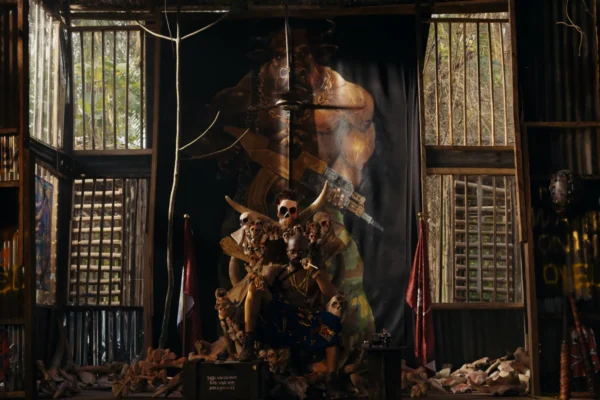
The disagreement surrounding Niyi Akinmolayan’s Colours of Fire offers one way into that question. The 2025 fantasy film brought together live action, visual effects, animation and generative AI in an ambitious attempt to create a distinctly Nigerian mythological world. Its reception exposed a disagreement that continues to shape discussions about AI filmmaking: should technological experimentation be celebrated for expanding what is possible, or judged by how successfully it serves the finished film?
Reviews in publications including TheCable, Premium Times, Afrocritik and The Nollywood Reporter differed in their assessments, but several returned to questions of visual integration, storytelling and the relationship between spectacle and narrative. One visible inconsistency in an AI-generated boat sequence is the word “Odyssey” appearing on the vessel. It is a small detail, but it highlights a larger problem: generated imagery can introduce inconsistencies that weaken the credibility of a world a film asks its audience to believe in.
However, Colours of Fire is better read as a case study of the expectations placed on new production methods than as a verdict on AI.
Beyond one film: What are Nigerian filmmakers doing with AI?
The conversation becomes more interesting when you consider Colours of Fire alongside other Nigerian productions. They show that AI filmmaking is not one fixed practice, nor do all filmmakers approaching the technology share the same ambition.
Makemation, directed by Michael “Ama Psalmist” Akinrogunde and produced by Toyosi Akerele-Ogunsiji, is a live-action feature about AI, not a wholly AI-generated film. It follows Zara Sodangi, a young girl whose ambition and interest in technology confront the limits imposed by poverty, gender, and access. The film’s interest in AI is therefore both thematic and practical: it explores technology as a possible instrument of social change while incorporating AI into a human-led production process.
The producer has discussed using MetaGPT in script development, while published accounts of its post-production describe human editing and quality control. TheCable praised its story and its exploration of AI. Makemation offers a useful counterpoint to the idea that AI filmmaking must replace actors, crews, or entire production processes with generated material; it shows how the technology can enter a film without becoming its entire creative identity.
Abiodun Odu’s Leila offers another perspective. The short film follows a teenager’s emotional attachment to an AI assistant. In a published interview with The Nollywood Reporter, Odu described his interest in making audiences uncomfortable about the possibility of AI becoming a substitute for human relationships.
The film’s reception also shows that audiences can appreciate its visual and performance elements while still questioning aspects of its narrative resolution. Engagement with AI does not exempt a film from ordinary dramatic scrutiny.
Odu’s Yoruba-language short Àjákà Lórí Òkun is a more direct experiment. He has described using hundreds of written prompts and generated sequences to build its characters, locations and images, and struggling to get AI systems to communicate Yoruba with the emotional accuracy the language requires. A system may produce a recognisable sentence without grasping the cultural context that gives it meaning.
Two features go further still. The Omegamax Conspiracy, promoted by its creator, Ope Banwo, as a fully AI-generated feature, drew reviews that acknowledged the novelty of the experiment while noting weaknesses in facial expression, lip-sync, dialogue and emotional performance. Generating moving images is not the same as creating convincing dramatic performances. Asiri Ilu Awon Osu (Mystery of Osu Land), a Yoruba feature film whose producers describe as largely AI-generated or AI-assisted, with a smaller live-action component, met reported streaming and payment difficulties at its premiere. A film must still reach an audience through working distribution infrastructure.
These projects should not be treated as interchangeable examples of an AI revolution. They represent different levels of technological integration and different creative intentions. Together they show that the conversation has moved beyond speculation, and that each result deserves to be judged on its own terms.
What are audiences and creatives actually arguing about?
The public conversation around these films has been almost as revealing as the films themselves. Discussions on social media, involving Nigerian filmmakers, critics, film enthusiasts and ordinary viewers, have produced several overlapping positions.
One group is concerned about standards. Critics have questioned the look of AI-generated imagery and whether filmmakers are submitting work that has not been sufficiently refined. The phrase “AI slop”, which has appeared in criticism of Colours of Fire, captures frustration with images that impress through scale but reveal inconsistencies. Some of this is aimed at the technology and some at the decisions made around it: a poorly integrated image may point to a problem of execution, not proof that AI has no place in filmmaking. Either way, audiences are entitled to expect the finished film to work.
Other voices defend experimentation. Some praise the ambition to expand what Nigerian filmmakers can put on screen, noting that production limits have long restricted the scale of Nollywood’s stories, and argue that the industry should learn to work with a technology unlikely to disappear. A related intervention pushes back on calling every unusual effect AI, stressing the difference between generative AI, CGI, and VFX. A debate built on inaccurate descriptions will struggle to identify what is actually changing.
A third position is conditional. Some are open to AI in specific uses, such as small-budget visual effects and B-roll, but wary of excessive use, asking whether a particular use is justified by a production’s needs.
Between these positions is a more conditional acceptance. Some participants have expressed openness to AI in specific applications, such as small-budget visual effects and B-roll, while remaining concerned about excessive use. This position is less interested in declaring AI good or bad than in asking whether a particular use is justified by a production’s needs.
The disagreement is not a simple war between progress and resistance. It reflects different expectations of filmmaking. Some ask what new possibilities the technology can unlock; others ask what standards and livelihoods might be sacrificed in the process. The first group risks treating access to a new tool as progress in itself. The second risks allowing the shortcomings of early experiments to become a verdict on the technology’s entire potential. Both positions need to be tested against the actual work being produced.
The experience elsewhere
Nollywood is not the first film industry to confront what generative AI means for creative work. Hollywood’s 2023 writers’ and actors’ strikes brought AI into negotiations over employment, authorship and performers’ likenesses. The Writers Guild of America secured provisions establishing that AI-generated material would not be treated as literary material written by a human writer, while writers could choose to use AI under specified conditions. SAG-AFTRA placed particular emphasis on consent and negotiated compensation for the digital simulation of performers’ voices and likenesses.
India offers another useful comparison. Its large, multilingual film industry is experimenting with AI for content generation, visual production, dubbing, and adapting existing films. A 2026 report by Digital Futures Lab, Putting Workers First: “Anticipating the Impact of Generative AI on the Creative Industry in India”, examines possible effects on workers including junior editors, voice artists, lighting technicians and set designers. It highlights people often less visible in discussions of technological progress.
The economics of a cheaper film
For an industry where financing remains a persistent challenge, AI’s appeal is understandable. A filmmaker who can generate a difficult location, create a visual environment or experiment with a sequence without organising an expensive physical production may be able to attempt a project that would otherwise remain out of reach.
But reducing the cost of making a film does not automatically solve the problems of sustaining a film business.
A film still needs an audience. It needs distribution, marketing, exhibition, or a viable streaming arrangement. Its producers need a way to recover their investment and, ideally, earn enough to finance another production. AI may reduce some production costs, but it cannot guarantee any of these outcomes.
Another question is who can afford to use the technology effectively. Access is not simply a matter of having an internet connection and an account on an AI platform. Subscriptions, foreign currency, hardware, connectivity, and technical expertise all affect what a filmmaker can do. A tool that appears inexpensive compared with a traditional production may still be inaccessible to a filmmaker with limited resources.
Research into AI adoption among Nigerian filmmakers has identified unequal access to subscriptions and infrastructure as concerns, alongside the possibility that AI could deepen existing differences between better-funded productions and those operating on smaller budgets.
What happens to humans?
This question is central to the debate.
Filmmaking is not simply producing images. It is an ecosystem of people whose work contributes to the development, execution, and circulation of a film. Writers, actors, editors, designers, sound and VFX artists, assistants, and technicians all participate in that process.
AI may change the demand for some of these roles. Certain tasks in storyboarding, concept design, VFX, dubbing, and pre-production may become faster or require fewer people. Other roles may evolve as workers learn to supervise, refine, and integrate AI-generated material into conventional workflows. New forms of technical and creative collaboration may also emerge.
But the possibility of new opportunities does not erase the possibility of displacement.
A 2026 study by Simon et al., A perspective from Nollywood: “Examining how generative AI is being integrated into the Nigerian film industry”, draws on interviews with 21 filmmakers. Its reported findings include concerns about unequal access, cultural misrepresentation and the potential displacement of specific forms of informal creative labour, particularly in pre-production. It also points to the disruption AI could bring to the informal professional networks through which people find work and build careers.
In an industry where employment often depends on professional relationships, repeated collaborations, and the gradual acquisition of experience on set, losing certain entry-level tasks could affect more than the immediate availability of jobs. It could narrow the pathways through which younger practitioners learn their crafts and acquire the skills required for more senior positions.
A further economic question remains: when a smaller team can accomplish work that previously required a larger one, who benefits from the savings? The producer, the investor, the platform, the remaining workers, or some combination of them? Efficiency is not inherently unfair, but how it is distributed is a matter of industrial choice.
Questions of consent and ownership matter just as much. An actor’s face or voice may be digitally replicated. A writer’s work may be used in training a model. A visual artist’s style may be imitated. Existing Nigerian copyright and performers’ rights frameworks provide relevant protections, but questions surrounding AI training data, synthetic performances and authorship of substantially AI-generated works remain unsettled.
Who gets to imagine Africa?
Generative AI systems are shaped by the data they are trained on. If African people, environments, languages, histories and cultural expressions are inadequately represented in those datasets, the systems may reproduce familiar distortions or struggle to generate culturally specific material convincingly.
The problem is not solved simply by asking an AI tool to produce an African setting. An image may look broadly African while misrepresenting a particular community, its clothing, architecture, language, or history.
Nigerian filmmaker and creative technologist Malik Afegbua offers an interesting way into this discussion. His work, including The Elder Series, uses AI-generated imagery to challenge the underrepresentation of older Africans in visual culture. His broader interest in digital cultural memory and African heritage raises a question beyond what the technology can generate: who controls the data and visual assumptions through which African identities are represented?
As Odu found with Àjákà Lórí Òkun, language carries cultural meaning that a system without that context can lose.
For Nollywood, technological participation should mean more than access to foreign tools. It should also involve developing and protecting African data, languages, intellectual property, and creative knowledge.
Is the industry preparing?
Nigeria has taken steps towards establishing a broader policy environment for artificial intelligence and intellectual property. The published National AI Strategy, the National Intellectual Property Policy and the Copyright Act 2022 all form part of the context in which the industry will have to negotiate the technology’s implications. But policies alone do not automatically translate into practical safeguards for filmmakers and creative workers.
A 2024 survey by DLA Piper Africa, authored by Sandra Oyewole and Caleb Nmeribe, identified gaps in AI awareness and contractual protection among respondents in the Nigerian film and television industry. Its findings suggested that questions of consent, intellectual property, and professional guidance were not yet receiving sufficient attention. The findings should be understood in the context of that survey, rather than treated as a complete picture of the industry today.
AFRIFF’s AI lab and the wider industry conversations surrounding its 2026 edition are useful developments. So are the Naija AI Film Festival and the growing interest in training and experimentation. They suggest that Nigerian creatives and institutions are beginning to engage with the technology more deliberately.
Still, training people to use AI is only one part of preparation. The industry also needs meaningful conversations about contracts, compensation, consent, access to technology, and protecting creative work. Professional associations, producers, platforms, policymakers, and workers will all have a role in determining how these questions are addressed.
Readiness is more than adoption
Nollywood does not need to reject artificial intelligence to protect its creative future. Nor does it need to embrace every new application simply because the technology exists.
AI can expand the possibilities available to filmmakers, but its presence does not guarantee artistic progress. Criticism can protect standards, but it should not automatically reject experimentation. Lower production costs can create opportunities, but they do not guarantee a sustainable industry or a fairer distribution of work.
Perhaps the most important distinction is between having access to a tool and having the capacity to build an industry around it.
If AI makes it possible for more Nigerians to tell stories, that is worth taking seriously. The people who have spent their careers telling, shaping, performing and producing those stories must also have a meaningful place in what comes next.
Nollywood’s readiness should not be measured only by how quickly it learns to use artificial intelligence. It should also be measured by what it chooses to protect, what it is willing to change, and who gets to participate in the future it is building.