After the Emmy and international recognition, Uzoma Dunkwu is looking beyond individual breakthroughs to the infrastructure Nigerian animation needs to build a lasting global presence. Uzoma Dunkwu has already seen what happens when Nigerian animation talent reaches the international stage.
Uzoma Dunkwu has already seen what happens when Nigerian animation talent reaches the international stage. He has worked in visual development and character design for major global studios, including Marvel, Netflix and Disney, and his portfolio traces a career that has moved between original African stories, animation direction, character development and some of the world’s biggest entertainment franchises.
In 2026, that journey reached a significant milestone when Dunkwu was named a juried Emmy winner for Outstanding Individual Achievement in Animation for Character Design on Marvel Animation’s Eyes of Wakanda episode, “Into the Lion’s Den.”
But when asked what Nigerian animation needs now, he does not begin with another award, another international production or another opportunity for Nigerian artists to get hired abroad.
He has three words.
Capacity. Capital. Clout.
“The industry needs what I call the 3Cs; Capacity, Capital & Clout,” Dunkwu says.
It is a simple framework for a complicated industry, but it captures something that is often missing from conversations about African animation. The conversation tends to begin and end with talent: who is drawing, designing, animating and telling the stories. Dunkwu’s argument is that talent is only one part of the equation.
The people have to be trained.
The work has to be financed.
And the achievements have to become visible enough to create more opportunities.
For Dunkwu, Nigerian animation has already proved that it can produce the first part. The industry, he says, has been “thriving for years” despite the challenges of doing business in Nigeria.
The problem now is how to build around that talent.
Capacity
Capacity begins with people.
Animation is a specialised discipline requiring artists who understand character design, visual development, storyboarding, movement, composition and the technical demands that turn drawings into moving worlds. It also requires producers, directors, writers and other professionals capable of taking a project from an idea through production and into an audience’s hands.
Dunkwu’s own route into the industry is instructive.
His professional profile identifies him as a writer/director and visual development artist, with an academic background in engineering at the University of Benin. His career has since moved through independent creative work and production into international animation, including visual development work at Marvel Animation.
His portfolio shows that evolution in practice. Before Eyes of Wakanda, his work included directing Black Panther – The Series, a 2019 concept project developed through Scroll Entertainment, visual development on Dawn of Thunder and animation direction on Wool Wool Town.
The Eyes of Wakanda opportunity eventually placed him inside Marvel’s visual-development process.
Dunkwu joined the project in August 2021 as an early concept artist, developing initial ideas for characters under director Todd Harris. His early designs for five Dora Milaje characters, including Noni, became a guide for the character development of the series. He later refined Noni and contributed designs across all four episodes.
That trajectory matters because capacity is not simply about having people who can draw.
It is about having people who can operate at the level required by increasingly ambitious productions.
Dunkwu’s answer to young artists reflects that distinction. His first advice is to find a unique voice. Excellence in the craft is essential, but so is visibility. Artists need to put their work where it can be seen, develop portfolios that communicate what separates them from everyone else, and remain open to opportunities.
The larger lesson is that talent development cannot be an afterthought.
An industry capable of sustaining animation at scale needs a deep pool of people who can do the work—and keep getting better at it.
Capital
Talent, however, cannot finance a production.
Dunkwu’s second C is capital: access to the money required to develop, produce and distribute animation.
He points specifically to grants and loans, but his thinking about financing extends beyond traditional funding. When he talks about international collaboration, he points to co-productions, intellectual-property acquisition, presales and exchange programmes as other ways the relationship between Nigerian and international animation industries can develop.
That is a significant shift in perspective.
The international industry does not have to be understood simply as a destination where Nigerian artists go to find jobs.
It can also be a network through which Nigerian productions are financed, developed, acquired, distributed and exposed to new audiences.
That distinction becomes especially important when Dunkwu talks about intellectual property.
For young artists trying to enter major studios, his advice is not to spend their careers waiting for a studio job. Develop the craft, yes. Build the portfolio, yes. But create something of your own.
“Develop your skills to the highest level and create your own intellectual property,” he advises. The reason is leverage.
An artist who owns an idea, a character, a world or a story and has built an audience around it enters a conversation with studios differently from someone who is only selling their labour.
That philosophy also speaks to a larger problem in African creative industries: the difference between participating in other people’s intellectual property and owning original work that can travel independently.
The former can provide valuable experience.
The latter can become an asset.
For an animation industry trying to grow, both matter.
Clout
Then comes the C that Dunkwu believes can help unlock the other two.
Clout.
For him, recognition is not merely a personal reward. It is an industry resource.
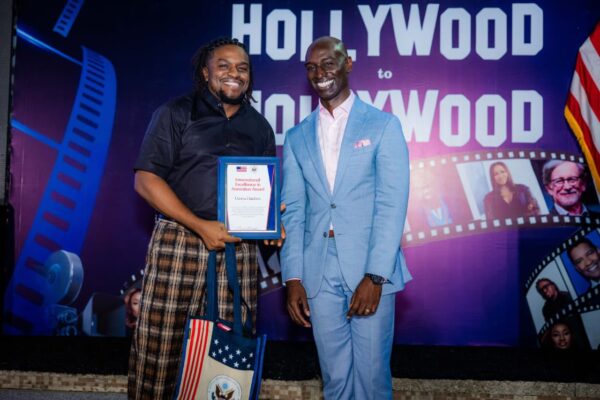
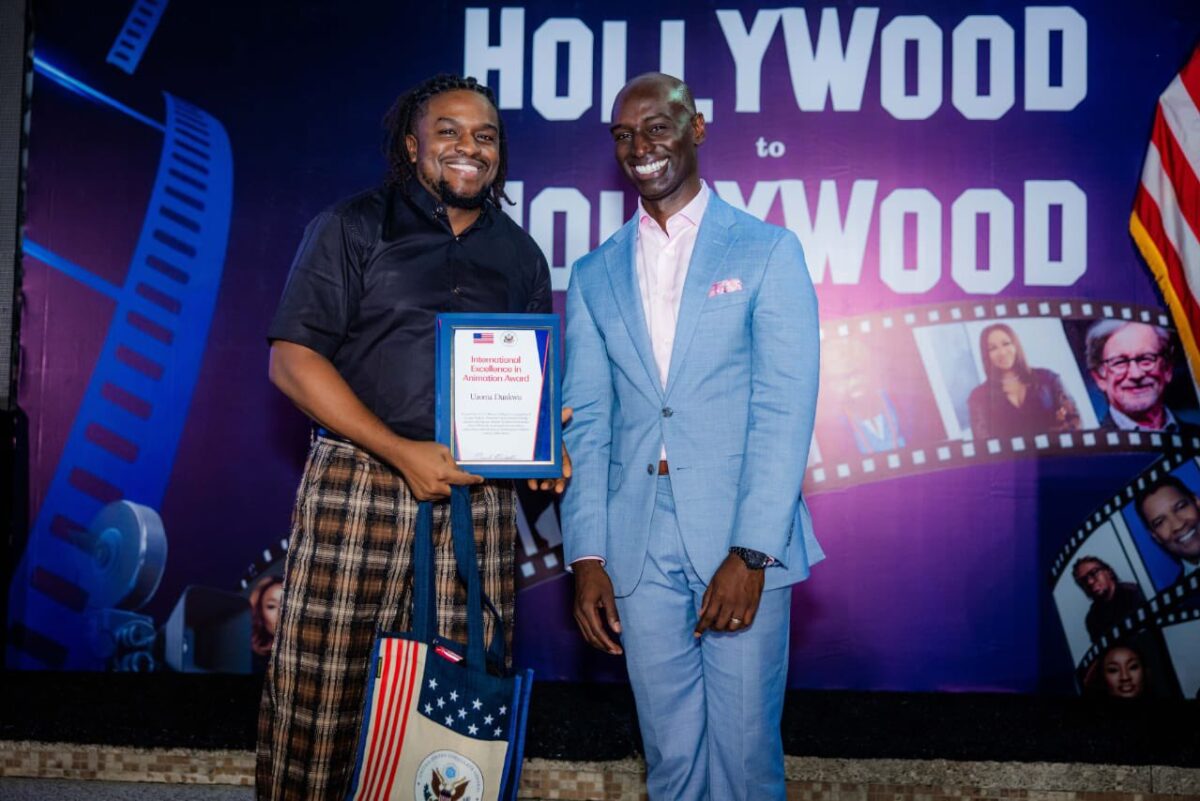
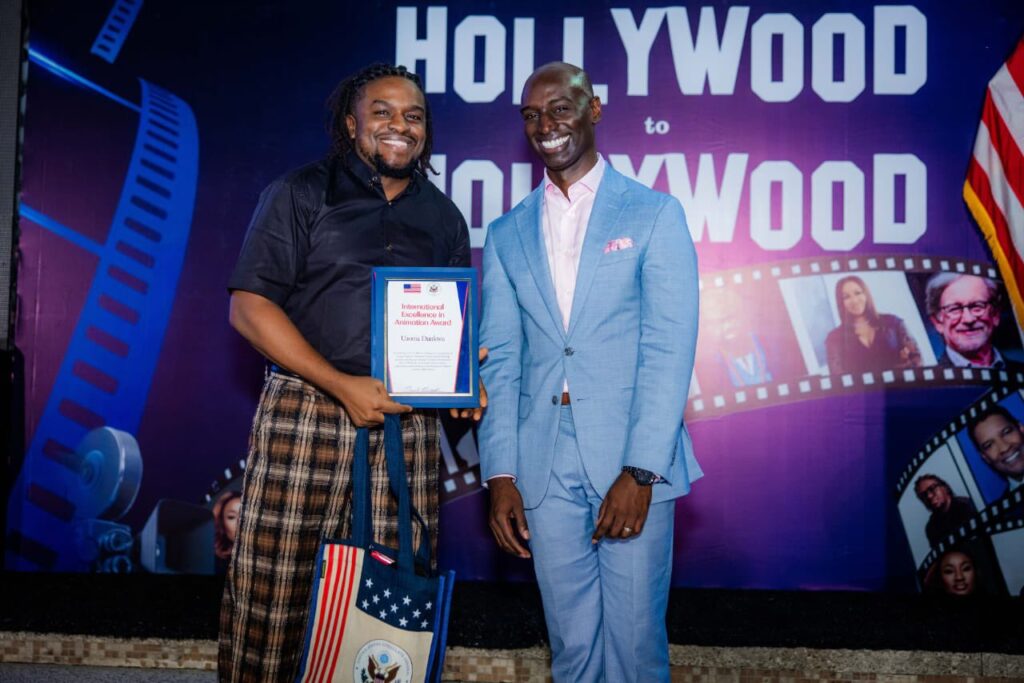
He describes his recent recognition from the U.S. Mission in Nigeria as “a much needed recognition for Nigerian talents in Animation.” The award, presented after his Emmy win, recognised his achievements and his contribution to cross-Atlantic creative collaboration. OYA has previously reported on that recognition.
But Dunkwu sees the value of such recognition beyond himself.
“This recognition from the U.S. Mission in Nigeria is clout,” he says. “It spotlights the industry globally and makes room for conversations with stakeholders in the public and private sector in order to accelerate the industry’s growth in the other areas (capacity and capital).”
That is perhaps the most revealing part of his 3Cs framework.
Capacity, capital and clout are not separate ambitions.
They feed each other.
More visible success stories can attract conversations with investors and institutions. Better financing can give skilled artists the opportunity to work on larger projects. Larger projects can produce more success stories. Stronger success stories can increase international confidence in the market.
The cycle can continue.
The challenge is getting it started at scale.
Dunkwu’s Emmy is therefore useful not simply because an individual Nigerian artist won one. The Television Academy’s record places him among the winners of the 2026 Outstanding Individual Achievement in Animation category for his character design work on Eyes of Wakanda.
The significance lies in what the achievement allows people to imagine. A Nigerian artist can be part of the creative process behind a major global animation franchise. And that artist does not have to erase his Nigerian identity to become useful to the global industry.
In Eyes of Wakanda, Dunkwu’s involvement was particularly fitting. His early character work helped shape the visual development of a series rooted in Wakanda, an imagined African civilisation whose history and identity sit at the centre of the story.
It is one thing for African artists to be present in global productions.
It is another for their cultural perspective to be part of why they are wanted there. Dunkwu believes that kind of collaboration needs to become more deliberate. And collaboration, in his view, cannot stop at freelancing or remote work.
It can mean studios working together. It can mean Nigerian intellectual property being acquired internationally. It can mean projects securing presales before production. It can mean exchange programmes that allow knowledge and skills to move in both directions.
The objective is not simply to export Nigerian talent.
It is to build an ecosystem capable of exchanging value.
What Comes After the Breakthrough
Perhaps the clearest indication of where Dunkwu’s own thinking is heading is what he plans to do next.
He says he is developing several projects, including an animated short with an Oscar-winning producer.
But alongside his own creative work, he is preparing to launch ARTIS — Animation Rising Talent Incubation Scheme, an educational programme designed to equip artists with the skills required for lucrative careers in animation.
The timing is significant.
After an Emmy, it would be easy to focus entirely on the next international credit. Dunkwu is also looking beyond his own breakthrough.
At the people who are still trying to find their way in.
At the artists who may have the talent but lack access to training.
At the creators who have an idea but no money to develop it.
At the industry whose achievements may still not receive enough attention outside its immediate creative community.
The next step, then, is not simply another award.
It is multiplication.
The goal is to make sure that the next Nigerian animator does not have to be an exceptional anomaly to reach the global stage.
There should be enough capacity for more people to be excellent.
Enough capital for their ideas to survive beyond the sketchbook.
Enough clout for their success to be recognised as evidence of an industry rather than an isolated miracle.
Dunkwu has already demonstrated what one Nigerian animator can do when the opportunity meets the preparation.
His 3Cs argument asks a more consequential question:
What could Nigerian animation become if the industry itself were prepared for the opportunity?
Written By Aaron Ayo Akinyemi
Interview by Michael Toruyai