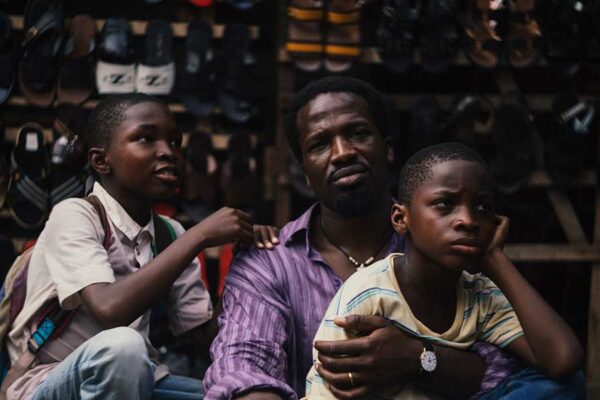
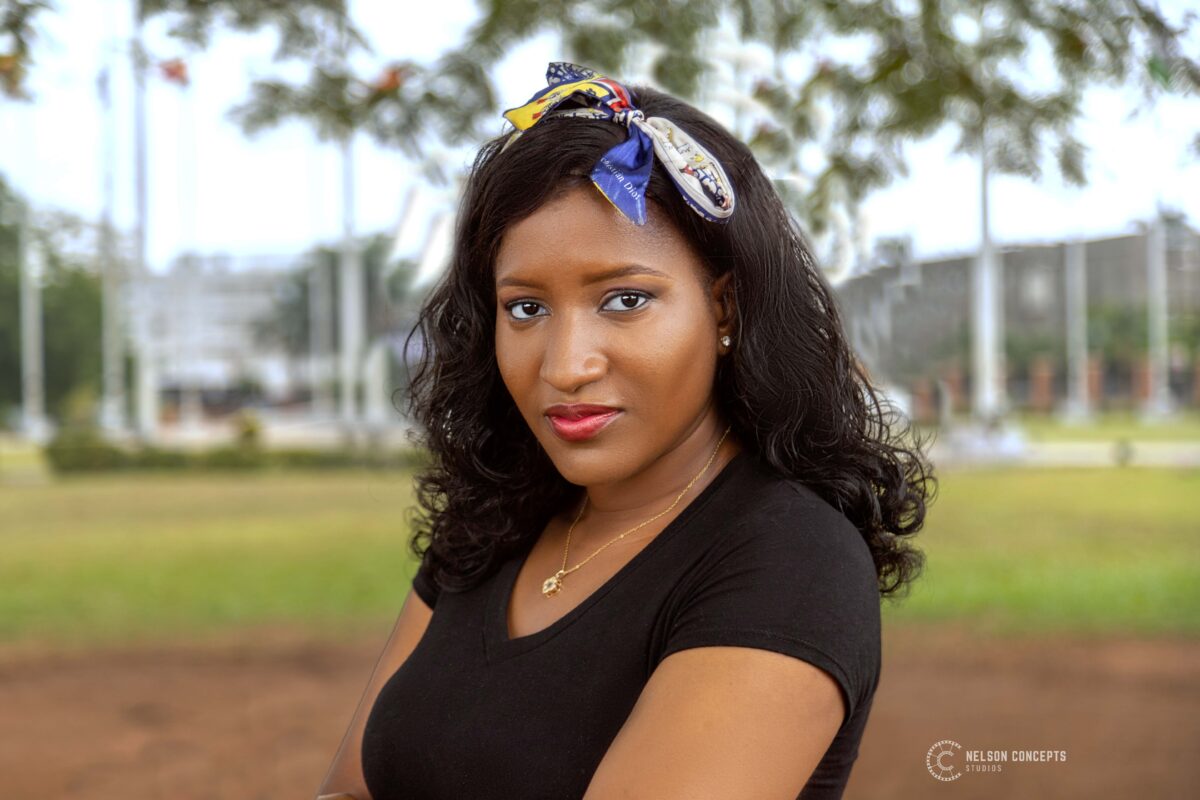
When a production begins to fall apart, Orobosa Ikponmwen has learned not to fall apart with it. She learned the lesson from Daniel Oriahi during her time at EbonyLife Creative Academy. Ikponmwen remembers it as a simple principle with an almost impossible demand attached: the entire production can be burning, but for the director, it does not. It is the kind of advice that sounds neat until you are standing on a set where the plan has begun to betray itself. Time disappears. Money tightens. A location refuses to cooperate. Something that looked perfectly reasonable on paper no longer works in front of a camera. People begin to panic. The instinct, especially when you care deeply about the thing you are making, is to panic with them. Ikponmwen has learned that this is precisely when the director must be most useful. “Keep your head and look after the story,” she says. “That is your responsibility.” She learned the lesson the hard way.
At EbonyLife Creative Academy, while making A Psalm for Abigail, a scene intended for daylight stretched into night. They had not planned for a night exterior, and what they captured was unusable. As the light disappeared, Ikponmwen noticed someone dancing for TikTok by the water. She went over and scolded them. Looking back, she feels she could have handled it better because the production problem wasn’t real, but because her frustration found someone who wasn’t responsible for it. “The time I used to shout should have gone into asking, ‘If we have to shoot this at night, how do we make it work?’” she says. “That is filmmaking: thinking creatively about solutions.” Eventually, she and her co-director found enough money to return the next morning and reshoot the scene. But the more enduring lesson wasn’t that they managed to fix the problem. It was that sometimes there would be no money for the next morning. There might be no extra day, no second chance, no convenient way back to the version of the film that existed in the director’s head. You make the film anyway.
Moving Pictures
Before she directed, Ikponmwen watched. She began by reviewing films before moving into screenwriting. Directing followed partly out of a practical desire: she wanted to make something that could demonstrate what she could write. But once she began directing, something else revealed itself. She liked assembling things. “I had these pictures in my head,” she says, “and I wanted to be the person saying, ‘Let’s do this. Let’s put this together.’” There is something telling in the way she describes that transition. Directing, for her, did not arrive as a grand declaration of authorship. It arrived as an instinct for arrangement—for seeing how people, performances and images might occupy the same space and become something coherent. Her early work included A Psalm for Abigail, the 2021 EbonyLife Creative Academy short she co-directed with Abigail C. Chukwu. The academy experience became an important part of her development, but it was not the beginning of her filmmaking life. She had already been making short films before entering the programme. What followed has been less a straight ascent than an expanding field of possibilities. There are stories about domestic violence, police brutality, family and young adults. Some films lean toward social drama, while others leave more room for comedy and friendship. Half of Me, directed by Ikponmwen and produced by Jade Osiberu, stars Nancy Isime, Martha Ehinome and Uzor Arukwe. Then there is Adanne, her feature-length directorial debut: a family drama moving through three generations of Nigerian women and the tensions of legacy, expectation and inheritance. The film’s scale tested precisely what she had been learning since those early shorts: how to hold onto a story’s core while everything around it keeps changing. Adanne was shot in Ibadan, and its production carried the familiar pressures of independent Nigerian filmmaking. Gold Gerry, the film’s writer and producer, says the central challenge was delivering the scale the story required with limited resources. That meant constant problem-solving, quick decisions and a team willing to find creative solutions without compromising the film’s emotional ambition.
Gerry says Ikponmwen brought an important balance to the production: protecting the creative vision while remaining practical, adaptable and collaborative. For Ikponmwen, the experience sharpened a skill she had already begun to understand. A feature, she says, is not one picture. A short can live in her head as a single image. A feature is an album: a collection of pictures that must each make sense independently while still belonging to the same whole. That distinction changed the way she approached directing. With one short, she might imagine the story through the eyes of a couple’s hypothetical child. With another, she might anchor the camera almost entirely to the protagonist. The question became not merely what happens, but whose experience determines what the audience gets to sees? Over time, that decision-making became faster. She can now read a script and see several possible ways into it. Perhaps that is partly what range means for her: not an absence of identity, but the ability to find a different doorway into each story.
Holding the Film Together
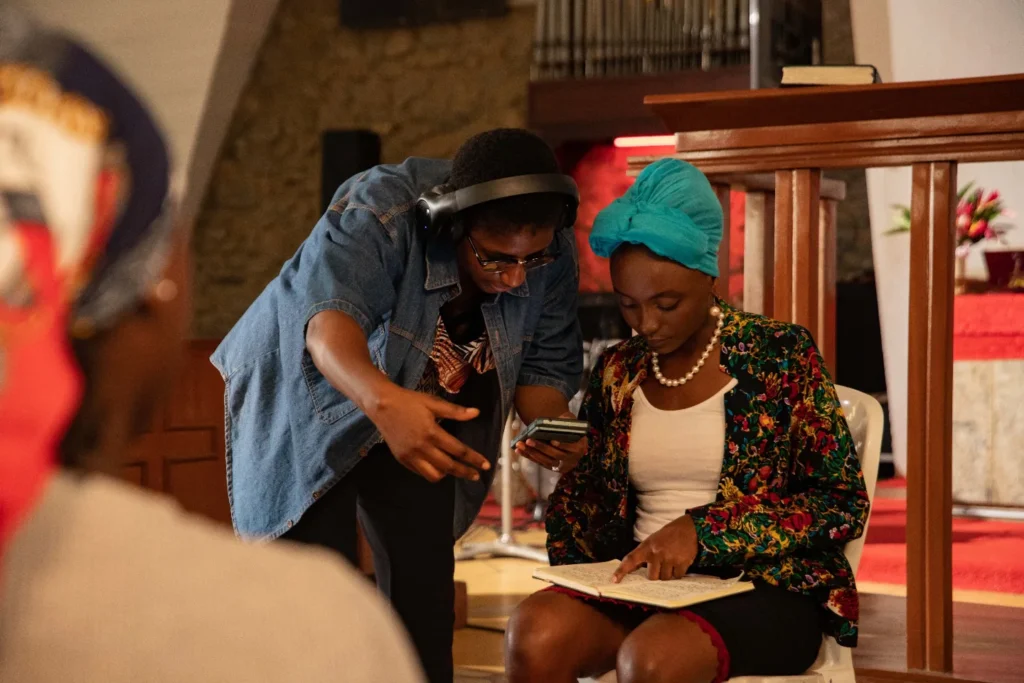
Her last two features pushed that ability further. Adanne required her to move between three generations and several periods, jumping between timelines rather than shooting each period as a contained block. The worlds had to feel distinct. The language of each period had to be considered. And the audience had to understand where the characters belonged within them. Then came another feature, one she cannot yet name. It was the kind of project she had imagined directing before she became a director. When the opportunity finally arrived, however, fantasy gave way to responsibility. “You arrive with big plans and then meet the realities that Nollywood and Nigeria throw at you,” she says. The task was not to preserve the original plan at all costs. It was to preserve the film. She compares the feeling to suddenly becoming president of a country everyone loves. The people around her—actors, extras, crew—had taken ownership of the project. That made the responsibility heavier. She could not let the country burn to the ground. The metaphor is playful, but the principle is serious. Directing is partly the art of knowing what you cannot sacrifice. It is also the art of knowing what can.
The Politics of Filmmaking
As her work moved from self-directed shorts into projects involving different producers, another part of directing became unavoidable: politics. “People management and politics,” she says. “The politics involved in filmmaking, especially as a director-for-hire, make me feel like I can run for governor now.” The joke lands because the work she is describing is less glamorous than the word director suggests. There are producers you answer to, heads of departments to collaborate with, crew members looking to you for direction and actors with their own interpretations. Everyone has emotions, expectations, and sometimes competing ideas about what the film should become. Ikponmwen describes the director as having to manage “upwards, downwards and sideways.” The difficulty is that being the creative custodian does not mean being the ultimate owner. A producer may want something different. A director may believe another choice serves the story better. Disagreement doesn’t automatically need to become a war. “I want this, you want that. How do we meet in the middle?” she says. That negotiation has become part of her craft. So has knowing when to let go. Sometimes, she says, you have to accept that something is not ultimately yours. But that does not mean surrendering your position. You still need to understand why you made a decision well enough to explain it—to hold your ground without turning the process into combat. It is another version of the same lesson she learned on that beach: composure is not passivity. It is control.
Nine People, One Story
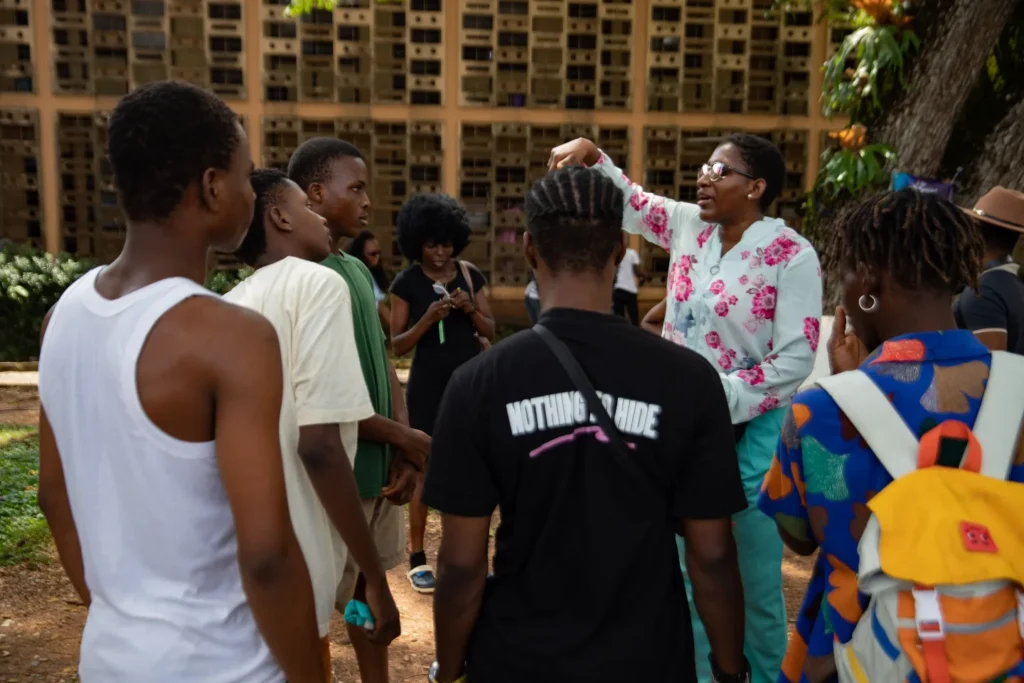
If Adanne tested Ikponmwen’s ability to manage scale and time, Pushing 30 tested something more intimate: people. The film follows a group of friends, with nine characters occupying different parts of the same social ecosystem. For Ikponmwen, making that friendship feel lived-in meant resisting the temptation to treat the actors as separate pieces. Before production, she spoke with each actor individually. Once they were on set, she brought them together. They talked through scenes as a group, sometimes with ten or twelve people sitting around a dining table discussing backstory, motivation and the relationships between characters. It mattered because performance is relational. One actor’s choice changes another actor’s response. A friendship that has supposedly existed for ten years cannot be built entirely through isolated performances and edited together later. Several cast members already knew one another, which helped. The rest of the familiarity had to be constructed. The work paid off in both efficiency and chemistry. Ikponmwen says the cast often understood what she wanted quickly, sometimes in a single take. The film is now headed for an October 18 premiere on Africa Magic Showcase, bringing the ensemble story of friendship, adulthood and the pressures surrounding thirty to a television audience.
It is also another useful contradiction in her body of work. Ikponmwen is often associated with stories that carry social weight. Pushing 30 gives her room to work with humour, friendship and the messiness of young adulthood. And she seems to enjoy the contradiction. “I did not want to box myself into making only one or two kinds of films,” she says.
What Belongs to Her
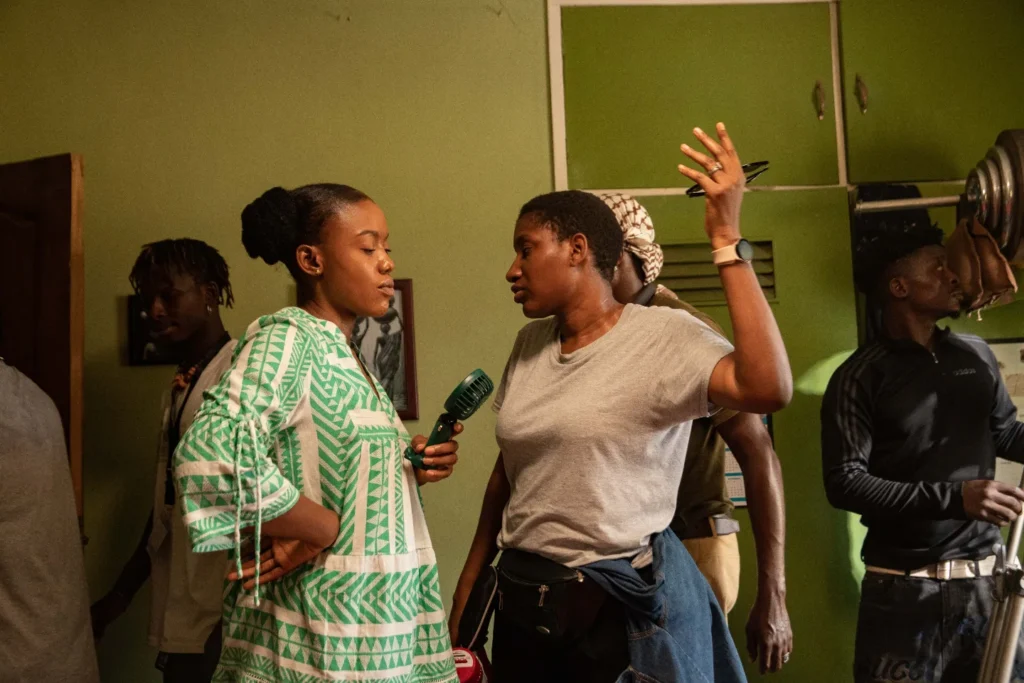
The obvious question, then, is what remains when the genres keep changing. If one film is a social drama, another a family story, another a young-adult film, and the next might be horror, where is the filmmaker in all of it? For Ikponmwen, the answer is not a fixed visual stamp. It begins with the story. “What does this story need?” she asks. “How can I elevate it? How can I bring myself to what it needs?” She does not begin by imposing herself on it. That philosophy has also changed the way she thinks about visual language. Early on, she admits, she barely understood filmmaking vocabulary. She did not know what a script looked like before writing one. She had not yet learned how production design, colour, framing, movement and light could alter what an audience understands. Now she thinks much more deliberately about what appears inside the frame. “Nobody cares that you painted the wall behind the camera,” she says. “The information you give the audience is what appears on screen.” The statement is almost blunt in its simplicity. It also describes the filmmaker she is becoming: less interested in the fact of an idea than in how clearly, precisely, and emotionally that idea reaches the audience. Research, she says, has become part of directing. So has collaboration. She has worked repeatedly with the same cinematographer and costume designer, learning that a director does not need to know everything, but must know what she wants well enough for others to interpret it. Her voice, then, may not be a particular genre or aesthetic. It may be a way of looking.
Beyond the Box
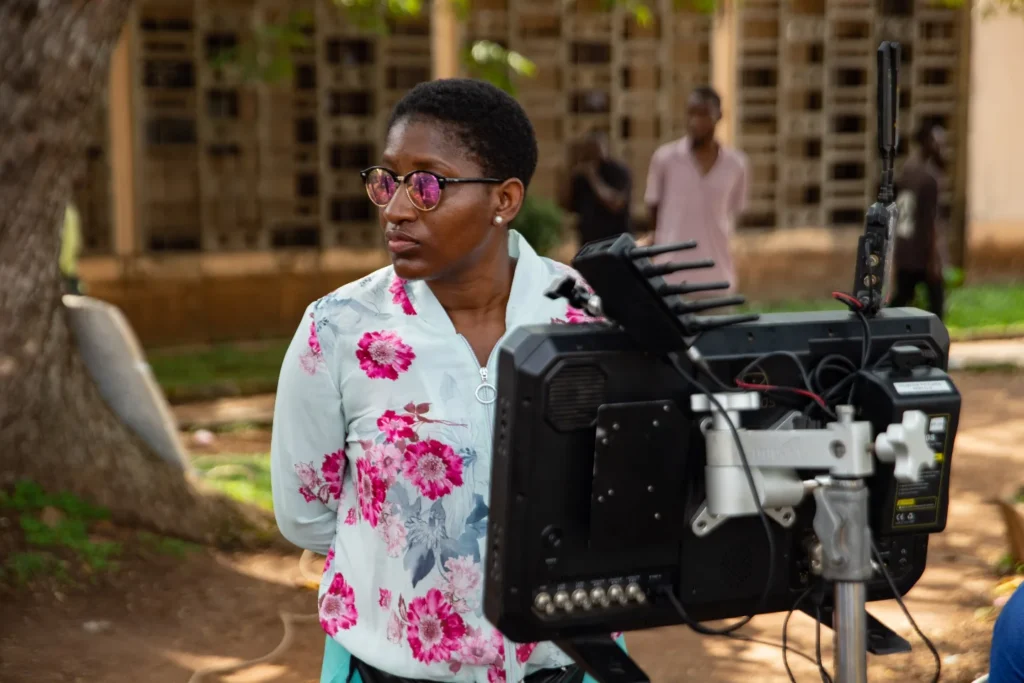
Ikponmwen knows the easiest way to make a career legible is to give it a category. Social-impact filmmaker. Family-drama director. Young-adult filmmaker. But categories can become cages. She is interested in stories that need to be discussed, but she does not want discussion to come at the expense of pleasure. Even a film about a serious subject, she believes, should be something people genuinely enjoy watching. Its ideas should remain with them after the credits, perhaps becoming conversation, perhaps becoming something larger. That is why the next horizon makes sense. She wants horror. More specifically, a psychological thriller. She is drawn to the possibility of a film that looks like a drama on the surface while carrying a thriller underneath. It would be another departure, but perhaps not as great a departure as it first appears. Because beneath the genres, the same question remains: what happens when people are placed under pressure? What do they hide? What do they reveal? What does a story ask of the people making it, and what does it ask of the people watching? Ikponmwen is still figuring out the answers. She does not pretend otherwise. “I am not yet where I want to be,” she says, speaking about her visual craft. “But I am getting closer.” Perhaps that is the most interesting thing about a filmmaker who refuses to be boxed in. The refusal is not merely about genre. It is about resisting the temptation to mistake the present for a final form. She has already moved from critic to writer, from writer to director, from shorts to features, from one kind of story to another. Adanne has begun its festival journey, while Pushing 30 moves toward its television premiere. But she doesn’t speak as though any of this has settled the question of who she is. Instead, she offers a broader instruction. “Life is too diverse and too beautiful to box yourself into one thing and decide you must die there if it does not work.” The world, she says, is wide. There are different facets. There is always something else to learn, another form to attempt, another story that might demand a different version of you. Do not define yourself only by what you are doing now. Or by what you have done before. And for a moving filmmaker, perhaps that makes all the sense.
She has moved from film criticism to screenwriting and directing, from shorts to features, and from social drama to ensemble comedy. Adanne is set to screen at the All African Independent Film Festival in Kigali in October and the Women of the Lens Festival in London in November, while Pushing 30 premieres on Africa Magic Showcase on October 18.
Interview by: Emmanuel Olabode
Written by: Aaron Ayo Akinyemi
Photo Credit: Chux Osakwe & Nelson Concepts